
Skinfinity Aesthetics Articles
Comparison of laser resurfacing technologies for skin treatment
You search “laser skin resurfacing” and end up with a wall of clinic pages, each one recommending a different device and making a different promise. CO2. Fractional. Erbium. Non-ablative. The terminology shifts depending on who’s writing, and after twenty minutes of reading you know less than when you started. That experience is frustrating, and honestly, it’s understandable. The field is genuinely complex, even for patients who’ve already sat through a consultation.
This article covers what laser resurfacing actually does to your skin, how the major technologies differ from each other, who it’s right for, and what realistic results look like, all without the upsell. Clinics like Skinfinity Aesthetics in Mississauga use these technologies within carefully structured, medically supervised protocols, and understanding the clinical context is a big part of knowing whether a treatment plan makes sense for you. By the end of this, you’ll know exactly what questions to ask before you commit to anything.
How laser skin resurfacing works
The core mechanism is controlled injury. Laser energy is directed at the skin, where it creates targeted thermal damage that triggers the body’s natural repair response. That response stimulates collagen production and replaces damaged cells with new ones, which is how the skin gradually improves in texture, tone, and firmness over weeks and months following treatment. This is what separates laser skin resurfacing from surface-level treatments like hydrafacials or chemical exfoliants. It works at a structural level, not just the surface.
The skin concerns it actually targets
The conditions with the strongest clinical support for laser resurfacing are acne scarring, sun damage and photoaging, uneven skin tone, fine lines, and general texture irregularities. Rolling scars and superficial boxcar scars respond particularly well. Ice-pick scars and deep boxcar scars respond less well regardless of which technology is used, so if those are your primary concern, set your expectations accordingly before booking any laser appointment.
Why the laser type you choose changes everything
Not all laser resurfacing is the same procedure with different branding. The device matters enormously. Whether the laser is ablative or non-ablative, fractional or full-field, determines how deep it reaches, how dramatic the results are, and how much recovery is involved. Understanding that distinction is the foundation for every other decision in this process.
Ablative vs non-ablative lasers: what the difference means for your results
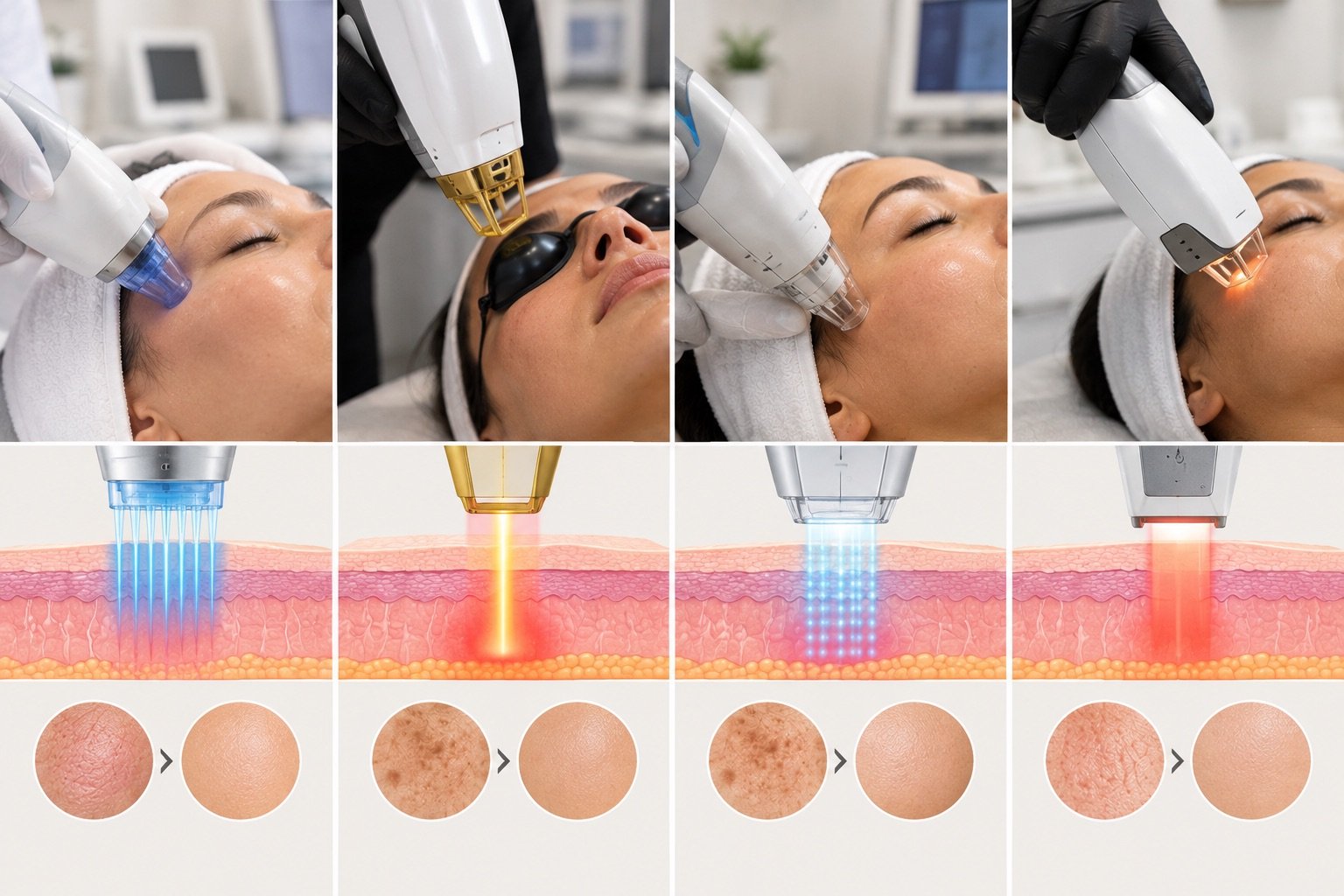
Ablative lasers, which include CO2 and erbium YAG, vaporize microscopic columns of skin tissue. Non-ablative lasers heat the dermis without breaking the skin’s surface at all. Ablative treatments generally produce more dramatic results but require longer recovery. Non-ablative treatments offer more gradual improvement with significantly less downtime. Neither is objectively better. The right choice depends on the severity of your concern, your skin type, and how much recovery time you can realistically accommodate.
CO2 laser resurfacing: the case for deeper treatment
CO2 is the most aggressive option in the ablative category. It’s typically chosen for deeper wrinkles, significant photodamage, surgical scars, and more pronounced texture problems. Results are often visible after a single session, but the recovery is correspondingly demanding. Fractional CO2, where the laser treats only a fraction of the skin in each pass, reduces complication risk compared to traditional full-field CO2 while still delivering meaningful resurfacing depth. Full-face ablative CO2 resurfacing in the GTA commonly runs from CA$2,000 to CA$6,500 or more per session, depending on the clinic and treatment intensity.
Erbium YAG resurfacing
Erbium YAG is also ablative but causes less thermal damage to surrounding tissue than CO2, making it better suited for more superficial resurfacing with somewhat less downtime. It sits in the middle of the spectrum: more targeted than non-ablative options but gentler than CO2.
Non-ablative fractional lasers
Non-ablative fractional lasers sit at the other end of the spectrum entirely. They leave the epidermis largely intact rather than ablating the surface, making them appropriate for mild to moderate concerns, earlier photoaging, and patients with deeper skin tones who carry a higher risk of post-inflammatory hyperpigmentation (PIH) with aggressive ablative treatment. Skinfinity Aesthetics offers the Lase MD Ultra, a non-ablative fractional laser used within a medically supervised setting in Mississauga. As with non-ablative fractional devices generally, it is suited for patients seeking skin rejuvenation with minimal social downtime, though results typically build across multiple sessions rather than a single treatment.
Are you a good candidate for laser skin resurfacing?
Candidacy isn’t purely about which skin concerns you want to address. Your skin type, tone, health history, and the expectations you bring to the consultation all factor into the equation. Assuming you’re automatically a good candidate because you’ve seen compelling before-and-after photos is skipping half the picture. A thorough evaluation from a qualified clinician is not optional; it’s the whole point.
Skin tone and Fitzpatrick type considerations
Darker skin tones, classified as Fitzpatrick types IV through VI, carry a higher risk of PIH after ablative resurfacing. This doesn’t disqualify those patients from laser treatment, but it does mean technology selection matters significantly. Non-ablative fractional lasers are generally the safer first-line option for skin of color, used with carefully calibrated settings and close clinical follow-up. Many clinics across the GTA treat patients with a wide range of skin tones, and any clinic you consider should have genuine experience doing so. Ask directly about their approach before you book.
Health factors and contraindications
Certain conditions make patients poor candidates for laser resurfacing. Active skin infections, recent use of isotretinoin (Accutane), a history of hypertrophic scarring or keloids, and some autoimmune conditions all affect eligibility. Patients with a history of cold sores should also know that ablative procedures can trigger herpes simplex virus (HSV) reactivation. Antiviral prophylaxis is standard protocol in those cases at a properly run clinic. If your consultation doesn’t cover these questions, that’s a meaningful sign about how that clinic operates.
What recovery actually looks like: a realistic timeline
Ablative laser resurfacing recovery
The recovery experience depends entirely on which technology is used, and softening that reality to make a treatment sound easier doesn’t serve you. After fractional CO2 resurfacing, most patients experience seven to ten days of visible downtime: redness, swelling, and peeling. Deeper or full-field ablative treatments can extend that to ten to twenty-one days. Residual redness can persist for several weeks after the skin has technically healed, and sometimes longer with more aggressive settings. Strict sun avoidance and careful post-care are not optional add-ons; they directly determine your complication risk. Clinical data puts infection rates at roughly 0.3 to 11 percent across ablative modalities, and PIH rates between 19 and 32 percent in some patient series. These numbers reinforce why experienced medical oversight matters more than the device name on the wall.
Non-ablative and fractional recovery expectations
Non-ablative fractional laser resurfacing typically involves redness and mild swelling for a few hours to one or two days. Most patients return to normal activities immediately or within a day. The tradeoff is straightforward: results are more gradual, and multiple sessions are usually required to reach the level of improvement that a single ablative treatment might deliver in one round. For many patients, especially those who can’t take ten days off work, that’s a reasonable trade.
How many sessions you need and results you can expect
There’s no universal answer, but reliable patterns from clinical practice give you a realistic baseline. The number of sessions required depends on what you’re treating, which technology you’re using, and your skin’s individual response.
Typical outcomes by skin concern
For fine lines and surface wrinkles, non-ablative or fractional protocols typically require two to four sessions with incremental improvement after each one. Clinical series report meaningful but partial improvement in fine lines across these protocols, though percentages vary by modality, patient, and study design. For acne scarring, four to six sessions spaced four to six weeks apart is a common protocol for non-ablative fractional treatment, with rolling scars and superficial boxcar scars responding best. For pigmentation and uneven tone, two to four sessions of non-ablative fractional treatment typically produce visible improvement, though results vary significantly based on skin type and ongoing sun exposure habits.
Questions to ask your clinician before booking
Before committing to any laser resurfacing treatment, bring these questions to your consultation. The answers will tell you a great deal about whether the clinic is operating with genuine clinical rigor or just selling treatments.
- Which laser technology are you recommending for my specific concern, and why that one over the alternatives?
- What is the expected number of sessions, and what will each session cost in total?
- What does recovery look like specifically for my skin type and tone?
- What complication risks apply to my health history andFitzpatrick type?
- What post-care protocol will I need to follow, and for how long?
- Is this procedure being performed under medical supervision?
A clinician who answers those questions directly and without deflecting is worth trusting. One who rushes past them or pivots to pricing before you’ve finished asking is worth leaving.
The takeaway before you book
Laser skin resurfacing is not a single treatment. It’s a category of procedures, each with different mechanisms, appropriate candidates, recovery demands, and result timelines. CO2 laser resurfacing delivers the most dramatic change but asks the most of you during recovery. Non-ablative fractional options like Lase MD Ultra, available at Skinfinity Aesthetics in Mississauga under medical supervision, deliver meaningful results with significantly less downtime. The right path depends on your skin’s specific needs, not on which treatment looks best in a promotional photo.
Go into your consultation armed with the questions above. The goal isn’t to pick the most aggressive option or the most affordable one. It’s to find the technology that fits your skin, your schedule, and what you can realistically expect from the process. A medically supervised clinic will help you get there. Book a consultation with our team at Skinfinity Aesthetics to talk through which approach is right for you.

Director, Aesthetician at Skinfinity Aesthetics
Request a Consultation
LIMITED APPOINTMENTS AVAILABLE