
Skinfinity Aesthetics Articles
What is the best treatment for acne scars?
Acne scars have a way of overstaying their welcome. The breakouts clear up, but the marks they leave behind can persist for years, sometimes decades. In our clinical experience at Skinfinity Aesthetics in Mississauga, patients consistently tell us that navigating acne scars treatment is where they feel most lost. The internet offers no shortage of opinions, but most are either too vague to act on or quietly contradict each other. This article is different. By the time you finish reading, you’ll know your scar type, understand what each clinical treatment actually does, and have a clear picture of what the next steps look like.
Here’s what most people miss upfront: there is no single best acne scars treatment. The right approach depends entirely on the type of scar you have, and that’s where most people go wrong. They chase a procedure rather than a diagnosis.
Not all acne scars are the same
Before any treatment decision makes sense, you need to know what you’re working with. Acne scars fall into two broad biological categories, and the treatments for each are completely different.
Atrophic scars: the three types most people have
Atrophic scars are depressed, meaning they sit below the surface of the surrounding skin. They form when the body doesn’t produce enough collagen during the healing process. There are three distinct subtypes, and most people have a mix of all three rather than just one.
- Icepick scars are narrow, deep, and pore-like, they look like someone pressed a sharp point into the skin. Because they’re deep and narrow, energy-based devices are generally less effective for this type than punch excision or TCA CROSS.
- Boxcar scars are wider depressions with defined, sharp edges, similar in shape to a box. They sit in a mid-range of treatment difficulty.
- Rolling scars have an undulating, wave-like appearance caused by fibrous bands of tissue underneath the skin that physically tether the surface downward.
Understanding which type you have changes everything about which acne scars treatment will work.
Hypertrophic and keloid scars: a different biological problem
Hypertrophic scars are raised, not depressed. They form when the body produces too much collagen, rather than too little. These are treated with intralesional corticosteroid injections and are biologically distinct from atrophic scars. Every treatment discussed in the rest of this article applies to atrophic scars specifically. If your scars are raised, flag this distinction before booking any resurfacing or microneedling procedure.
Acne scars treatment options: microneedling, laser, and beyond
Microneedling for acne scars: what it can realistically do
Microneedling is one of the most accessible and well-tolerated entry points into acne scar revision, but its effectiveness varies significantly depending on your scar type.
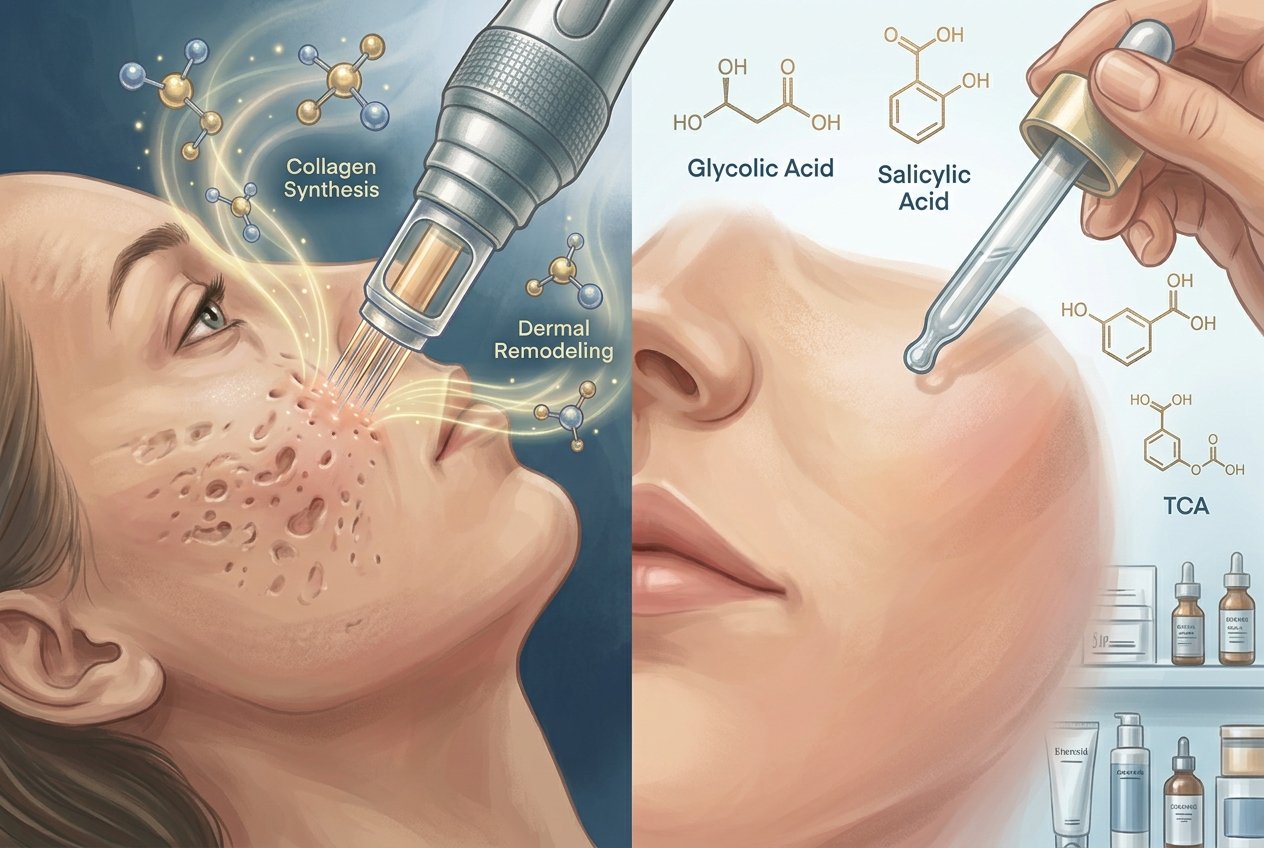
Microneedling creates controlled micro-injuries in the skin, which triggers the body’s natural collagen production response. Standard microneedling achieves this through mechanical channels alone. Radiofrequency (RF) microneedling adds thermal energy at the needle tips, which deepens the remodeling signal and generally produces stronger results for atrophic scars. RF microneedling works best for rolling and boxcar scars. When used as a standalone treatment for icepick scars, it produces the most limited improvement of any modality.
A typical treatment plan involves 3 to 6 sessions spaced 4 to 6 weeks apart. Downtime is usually 1 to 3 days of redness and sensitivity, making it one of the more manageable options for people with active schedules. Improvement is gradual and continues for several months after each session as new collagen matures.
It’s worth being direct about expectations: RF microneedling generally delivers 25 to 75 percent improvement for moderate atrophic scars, not complete elimination. That’s meaningful progress, but it’s not a one-and-done outcome. In the Greater Toronto Area, microneedling sessions typically cost around CA$350 to CA$450 per session, with RF microneedling priced higher depending on the device and add-ons used.
Laser resurfacing for acne scars: the stronger option
For patients with moderate to severe atrophic scarring, fractional laser resurfacing steps up the intensity of treatment and, in many cases, the results.
Fractional CO2 laser ablates microscopic columns of tissue, creating a more aggressive remodeling signal than RF microneedling. Meta-analyses find the two approaches produce comparable overall efficacy for atrophic scars, but fractional CO2 may give slightly stronger results in a single course. The tradeoff is more downtime and a higher risk of post-inflammatory hyperpigmentation (PIH), particularly in darker skin tones. For Fitzpatrick skin types IV through VI, RF microneedling is typically the safer and more appropriate starting point.
Fractional laser resurfacing in the GTA typically ranges from CA$500 to CA$1,200 or more per session, depending on the device and the clinical setting. Most patients need 3 to 5 sessions for meaningful improvement.
Recovery from more aggressive laser settings involves redness, swelling, and some crusting, with visible healing usually resolving within one to two weeks. Redness can persist longer. Final scar improvement often continues for three to six months post-treatment as new collagen organizes beneath the surface. For patients with more sensitive skin or limited downtime, gentler fractional options, available at medically supervised clinics like Skinfinity Aesthetics, can serve as a useful starting point and be integrated into a staged approach that builds toward more intensive treatment over time.
Chemical peels and TCA CROSS: where they actually fit
Chemical peels are often marketed as a versatile scar solution, but the reality is more specific. Understanding where they genuinely help prevents wasted time and money.
Superficial and medium-depth chemical peels improve skin texture, tone, and the post-inflammatory hyperpigmentation that often surrounds acne scars. They don’t, however, meaningfully change the depth or structure of true atrophic scars. Peels are best used as part of a broader acne scars treatment plan: addressing the discoloration around scars while other modalities address the structural damage underneath. Deeper peels carry higher risks and are rarely the right standalone choice for scar revision.
TCA CROSS (Chemical Reconstruction of Skin Scars) is a precise technique where high-concentration trichloroacetic acid is applied directly into individual icepick scar openings. This targeted approach is the most supported non-surgical option specifically for icepick scars. Clinical studies report good to excellent improvement in the majority of treated patients, with some studies reporting around 70 to 94 percent of patients achieving meaningful reduction after 3 to 6 sessions.
Downtime includes several days of scabbing and redness. Pigmentation changes are possible and more likely in darker skin tones, which is why TCA CROSS must be performed by an experienced clinician who adjusts concentration carefully. When done correctly, it’s the standout option for a scar type that other devices simply can’t reach effectively.
Combination approaches: why one treatment is rarely enough
The strongest clinical outcomes for acne scar revision come from combination treatment protocols, not single procedures. A staged protocol that sequences treatments by scar type consistently outperforms any single-modality approach in the clinical literature.
Subcision and fillers for rolling scars
Rolling scars are physically tethered to deeper tissue by fibrous bands. Surface treatments like microneedling and laser can stimulate collagen above those bands, but if the bands remain intact, they continue pulling the skin down and limiting results. Subcision addresses this root cause directly by inserting a needle beneath the scar to sever the fibrous connections and allow the skin to lift.
Subcision is most effective when combined with a hyaluronic acid or biostimulatory filler injected into the treated pocket immediately after the bands are released. The filler supports the lifted tissue, prevents re-adhesion, and restores volume in the area. Clinical reviews consistently describe this combination as the most effective approach for rolling scars, producing meaningful improvement, often around 50 percent or more, with some patients needing more than one round of treatment for optimal results.
Building a multi-treatment plan at a clinic like Skinfinity Aesthetics
The pattern that consistently produces the best long-term outcomes in clinical literature is staged, combination treatment rather than a single modality. A well-designed plan might look like this: subcision to release rolling scars first, followed by a series of RF microneedling sessions to drive collagen remodeling, with a chemical peel series running alongside to address surface texture and surrounding pigmentation. Each component targets a different layer of the problem.
At Skinfinity Aesthetics in Mississauga, multiple acne scar revision treatments are available under one medically supervised roof, which makes it practical to build a staged, personalized plan rather than adapting your skin to whatever a single-modality clinic happens to offer. A truly effective plan needs to account for each scar type present in your skin, your skin tone and PIH risk, and your lifestyle and recovery capacity. When all of these options are accessible in one place, the treatment plan can be built around you. That’s what separates proper acne scars treatment from booking a single session and hoping for the best.
At-home care vs. when to book a professional consultation
Topical skincare plays a real but limited role in acne scar management. Knowing where that limit is helps set realistic expectations and prevents years of hoping a serum will do what a procedure is needed to accomplish.
What skincare can and cannot do for established scars
Retinoids, vitamin C, niacinamide, azelaic acid, and AHAs genuinely support skin health. They reduce post-inflammatory hyperpigmentation, improve texture in the skin surrounding scars, and protect the results of clinical treatments. What they cannot do is remodel structural scar tissue, fill in depressed scars, or release tethered rolling scars. These are maintenance tools, not acne scar removal solutions. Managing active breakouts with a consistent skincare routine is genuinely important, preventing new scars is far easier than treating existing ones, but that’s a prevention strategy, not a revision strategy.
Signs it’s time to book an acne scar consultation
Several signals suggest it’s time to move from skincare to clinical acne scars treatment. Many clinicians use these as practical guidelines:
- Your scars have been present for more than a year without visible fading
- They’re affecting your confidence or daily life
- Topical products haven’t changed their appearance after six or more months of consistent use
- You notice a mix of scar types across different areas of your face
Any one of these is enough reason to seek a professional assessment.
A thorough consultation, consistent with best-practice guidance for pre-procedure assessment, should include a visual evaluation of scar type and depth, a discussion of skin tone and PIH risk, a realistic timeline for improvement, and a layered treatment plan. Be cautious of any provider who recommends a single session without first assessing your scar subtypes. Before you book, ask about the number of sessions expected, the typical downtime, and whether combination treatments would outperform a single approach for your specific presentation.
The clearest path to better skin
The best acne scars treatment isn’t a single procedure. It’s the right combination of procedures matched to the specific scar types in your skin. Microneedling, laser resurfacing, TCA CROSS, subcision, and dermal fillers each have a defined role and a defined limitation. Used in isolation, any one of them will underperform compared to a thoughtfully staged plan that accounts for your scar types, skin tone, and lifestyle.
The clearest path forward is an honest consultation with a medically supervised provider who can assess all three factors and build a plan that reflects them. If you’re ready to take a structured approach to acne scar revision, reach out to our team at Skinfinity Aesthetics to book your consultation. We’ll assess your skin, be direct about what’s achievable, and build a plan that actually matches your goals.

Director, Aesthetician at Skinfinity Aesthetics
Request a Consultation
LIMITED APPOINTMENTS AVAILABLE