
Skinfinity Aesthetics Articles
Can laser resurfacing remove scars?
There’s a particular kind of frustration that comes from spending years on skincare products that promise results and deliver very little. You look at an acne scar that’s been there since your twenties, or a patch of sun damage that no amount of vitamin C serum has touched, and you start wondering whether a laser can actually do what a shelf full of products couldn’t. At Skinfinity RX in Mississauga, that question comes up in nearly every skin consultation: not just “does laser resurfacing work?” but “will it work for me, for this?”
The honest answer is nuanced. Laser resurfacing, whether ablative, fractional, or non-ablative, can significantly improve scars, sun damage, fine lines, and uneven texture. What it generally can’t do is erase them completely. That distinction matters before you commit to a skin rejuvenation laser treatment, and understanding why it matters starts with understanding what the procedure actually does to your skin.
This guide walks through the mechanism, the different laser types, who responds best, what realistic results look like, and what recovery actually involves. By the end, you should be able to walk into a consultation with the right questions already in hand.
How laser resurfacing actually works on your skin
The principle behind laser resurfacing is counterintuitive. The treatment works by creating precise, controlled injury to the skin. That sounds alarming, but the logic holds: when skin sustains a calibrated wound, the body responds by generating new collagen and replacing damaged cells with healthier tissue. The laser isn’t just removing damaged surface skin, it’s triggering structural repair from within the dermis.
Different wavelengths of laser energy penetrate to different depths. That depth determines the type and degree of change you can expect. A laser that works at a superficial level will improve texture and tone. A laser that reaches deeper into the dermis can remodel the structural collagen that gives skin its firmness and affects how scars sit within the tissue. The deeper the treatment, generally speaking, the more significant the result and the longer the recovery.
One thing worth setting straight early: the final result from laser resurfacing doesn’t show up immediately after the session. The initial response is swelling and redness, not a transformation. Collagen production is a slow, progressive process that unfolds over weeks and months. This is why patient expectations around timing matter so much, and why a single treatment rarely tells the whole story.
Ablative, non-ablative, and fractional: what the difference actually means for you
If you’ve done any research on laser treatments, you’ve probably encountered these terms and found them less than helpful. Here’s a practical way to think about them: every type of laser treatment sits somewhere on a spectrum between “how significant is the result” and “how much downtime am I taking on.” Where you land on that spectrum shapes everything, including your laser resurfacing risks and benefits.
CO2 and erbium lasers: the deeper options
Ablative lasers remove the outer layer of skin entirely and heat the tissue beneath it. CO2 laser resurfacing is the more powerful of the two. It penetrates deeper and creates more thermal energy in the dermis, which translates to stronger collagen remodeling and more significant improvement for deep wrinkles and structural acne scars. The tradeoff is meaningful downtime, up to two weeks of visible healing and prolonged pinkness that can last several months in some cases.
Erbium:YAG lasers are more precise, with less thermal injury to surrounding tissue. They heal faster, carry a better complication profile, and present lower risk of pigmentation changes. The limitation is that they produce less tightening and may be less effective for deep or severe scarring. Erbium is generally the better choice when faster recovery matters more than maximum remodeling in a single session.
Fractional lasers: where most modern treatments start
Fractional laser resurfacing treats only a fraction of skin at a time, delivering energy in microscopic columns while leaving the surrounding tissue untouched. Those intact areas act as reservoirs for healing, which is why fractional treatments have considerably shorter downtime than fully ablative resurfacing. The skin re-epithelializes faster, complications are less frequent, and the risk of pigmentation changes is meaningfully lower.
The practical tradeoff is that fractional treatments usually require more sessions to achieve results comparable to a single aggressive ablative procedure. For most patients exploring laser treatment without the ability to take two weeks off, fractional is where the conversation starts. A series of three to six sessions over several months often delivers gradual but visible improvement in texture, tone, and scar appearance, without a prolonged recovery after each one.
Who is actually a good candidate for laser resurfacing?
The concerns that respond best to laser resurfacing are atrophic acne scars (the depressed, pitted kind), sun damage, uneven skin texture, and fine lines. If you’re managing any of those concerns, you’re likely a reasonable candidate for some form of this skin rejuvenation laser treatment. The more important question is which type of laser suits your specific skin, and that answer depends heavily on your skin tone.
Skin tone and why the Fitzpatrick scale matters here
For people with deeper skin tones (Fitzpatrick types IV through VI), the risk of post-inflammatory hyperpigmentation (PIH) after laser treatment is meaningfully higher than for lighter skin. Research on ablative resurfacing has documented PIH rates as high as 68% in Fitzpatrick type IV patients. That number is not a reason to avoid treatment; it’s a reason to choose the right treatment and the right clinic.
Non-ablative and carefully calibrated fractional lasers have significantly better safety profiles for darker skin. In studies of non-ablative fractional 1550-nm resurfacing in Fitzpatrick types IV through VI, PIH rates were around 4% per session, with most cases being brief and transient. The settings, the laser platform, and the clinician’s experience with your skin type all influence that outcome. In Mississauga, where the population is genuinely diverse, this is a routine clinical consideration, not an edge case. A supervised consultation before any treatment is non-negotiable.
What realistic results actually look like
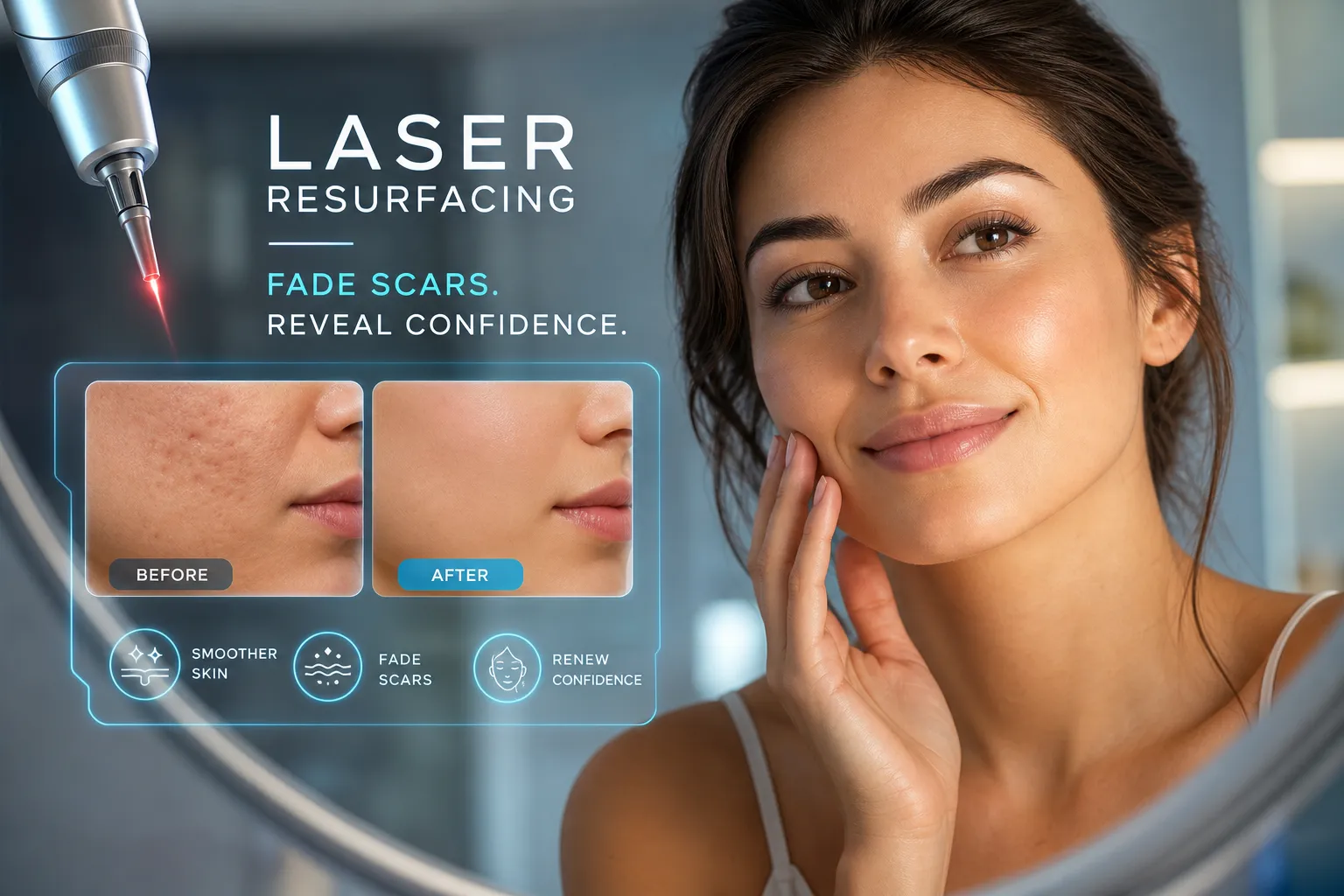
Laser resurfacing improves scars; it doesn’t remove them. That’s the most important sentence in this article. What the treatment does is remodel the skin’s structure so that scars become significantly less visible. For acne scars and sun damage, that can mean going from something that visually dominates your skin to something that blends in. That’s a meaningful, life-changing result for many patients, but calling it “removal” sets an expectation the biology can’t meet.
For fine lines and mild texture issues, two to three fractional sessions often produce meaningful improvement. Acne scars generally need three to six sessions, and deeper or older scarring may require more. Sun damage and pigmentation improve progressively over a series, with each session building on the last. A single aggressive ablative session can produce more dramatic change but comes with substantially more recovery and higher risk.
The improvement arc is worth understanding clearly. After the first session, you’ll likely notice a temporary glow from the healing process, not yet the structural change that comes from collagen remodeling. By the second and third session, texture and tone begin to shift in ways that are visibly noticeable. The full result from a complete series often peaks several months after the last treatment, as newly formed collagen matures. Results from stronger ablative procedures can last up to five years; fractional and non-ablative results typically benefit from periodic maintenance over time.
What recovery actually looks like week by week
Recovery from laser resurfacing follows a predictable pattern, and knowing what to expect makes the process far less stressful. Understanding laser peel recovery time upfront helps you plan realistically, both for your schedule and your expectations.
The first two days bring redness, swelling, warmth, and sensitivity. For fractional non-ablative treatments, this phase is mild to moderate and usually settles within a few days. For ablative procedures, the response is more pronounced, with crusting and oozing possible in the first 48 hours.
Days three through eight typically involve peeling and flaking as the damaged surface sheds. This is the stage where picking or scrubbing the skin causes real damage, so leaving it alone matters. By the end of week one, lighter fractional treatments are often largely healed. CO2 and deeper ablative treatments may show active healing into week two, with residual pinkness continuing for weeks to months afterward as collagen remodeling progresses.
Aftercare for all laser types follows a consistent set of principles:
- Keep skin moist with the occlusive product your clinician recommends, especially in the first few days.
- Avoid sun exposure entirely during healing, and use broad-spectrum sunscreen once the skin has closed.
- Skip harsh actives like retinoids, exfoliants, and acids until your clinician clears them.
- Do not pick at peeling skin or crusts; let the surface shed on its own timeline.
Common side effects across all laser types include redness, temporary swelling, and skin sensitivity. Less common but possible complications include acneiform eruptions, reactivation of herpes simplex in those with a history of cold sores, and pigmentation changes. Scarring is rare and is most associated with deep ablative treatment, excessive energy settings, or inadequate post-treatment care. The risk profile shifts with skin tone: darker phototypes face higher PIH rates, which is a strong argument for choosing a clinic with genuine clinical supervision and experience treating diverse skin.
How to choose the right laser resurfacing treatment in Mississauga
Before booking any laser resurfacing in Mississauga, there are a few questions worth asking directly. What laser platform will be used, and why is it appropriate for your specific concern and skin tone? What is the clinician’s experience treating your Fitzpatrick type? How many sessions are realistically needed, and what does the total cost look like across a series? What aftercare support is included? A provider who answers these questions clearly and without pressure is worth the consultation fee.
At Skinfinity RX, the Lase MD Ultra is a fractional non-ablative laser resurfacing system used under medical supervision to improve skin tone, texture, acne scars, and sun damage. It works progressively, with shorter downtime than fully ablative approaches, and with the clinical oversight that makes treatment safer across the range of skin types common in the GTA. For anyone exploring laser resurfacing in Mississauga for the first time, a supervised consultation at Skinfinity RX is a practical first step before committing to any treatment plan. You leave with a clear picture of what’s realistic for your skin, not a general answer, but a specific one.
So, can laser resurfacing remove scars?
The honest answer is: not remove, but significantly improve. Laser resurfacing remodels the structural tissue beneath the scar, making it less visible over a series of treatments. The same principle applies to sun damage and uneven texture: progressive improvement rather than erasure. For many patients, the end result is skin they feel genuinely comfortable in again, which is the actual goal.
The right laser type, the right number of sessions, and the right clinical oversight determine whether you get there safely and effectively. Choosing a clinic that combines medical supervision with real experience across diverse skin types isn’t just a preference; in a city as multicultural as Mississauga, it’s the standard you should expect. If you’re ready to move past wondering whether this could work for you, the most useful next step is a personalized consultation at Skinfinity RX, where “will it work for me, for this?” gets a specific answer rather than a general one.

Director, Aesthetician at Skinfinity Aesthetics
Request a Consultation
LIMITED APPOINTMENTS AVAILABLE