
Skinfinity RX Articles
Microneedling vs Chemical Peel: Which Is Right for You?
At least once a week, someone walks into a clinic and asks the same question: “Should I get microneedling or a chemical peel?” Microneedling vs chemical peel is one of the most common comparisons in medical aesthetics, and the honest answer is that both treatments work. They just work differently, for different skin concerns, on different timelines. Some online sources skip that distinction entirely, which is where the confusion starts.
Choosing between these two treatments isn’t about which one is better in the abstract. It’s about which one is better for you. Your skin tone, your primary concern, your schedule, and your budget all shape that answer. This guide walks through each factor clearly so you can walk into a consultation already knowing what questions to ask.
What each treatment actually does to your skin
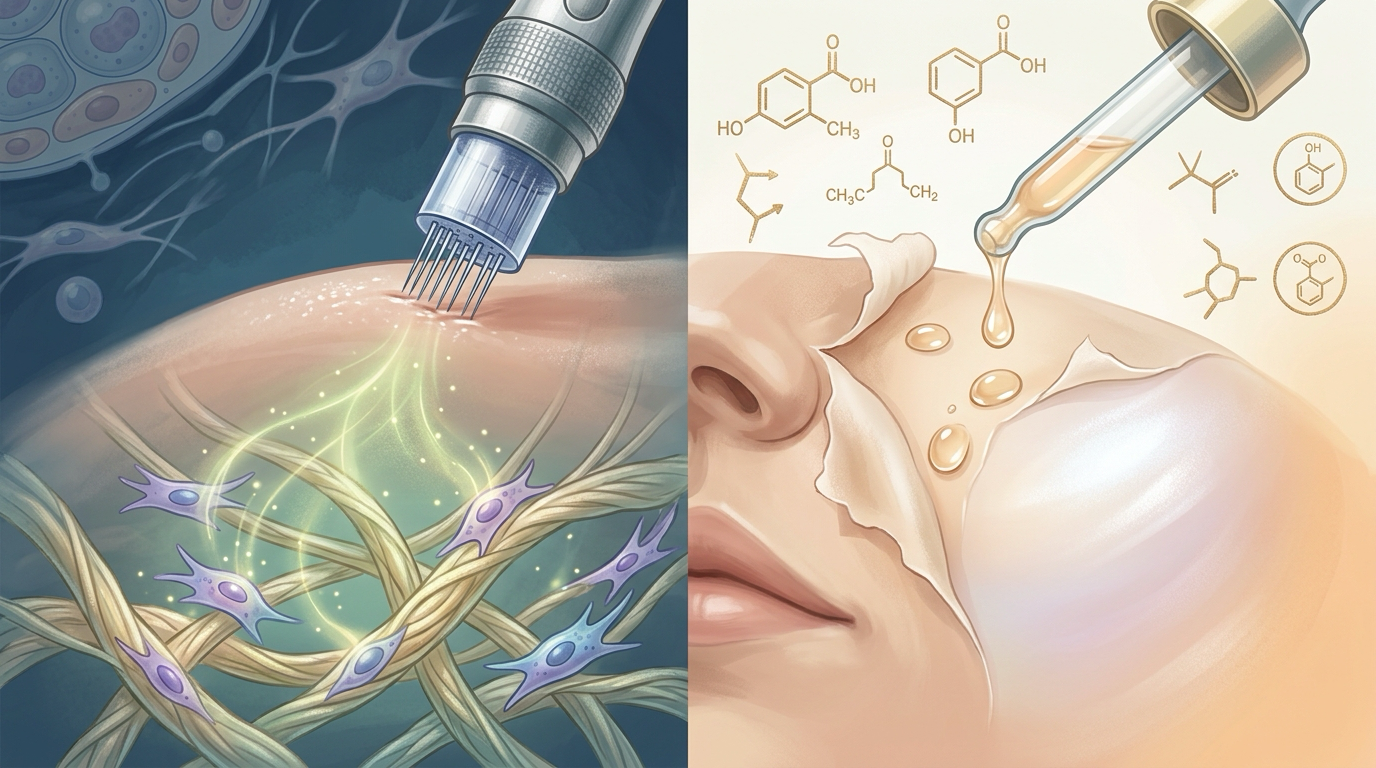
The most useful way to understand these two treatments is to think about direction. Microneedling works from the inside out. Chemical peels work from the outside in. That single distinction drives almost every comparison that follows, including how each treatment handles scarring, pigmentation, recovery, and cost.
How microneedling stimulates collagen from the inside
Microneedling uses fine needles to create controlled micro-channels in the dermis, the layer beneath your visible skin surface. Your body reads those micro-injuries as damage and responds by producing new collagen and elastin. The skin that rebuilds after a microneedling session is structurally denser and more even than what was there before. RF microneedling takes this further by delivering radiofrequency heat energy through those same channels, which amplifies the collagen response and adds benefit for skin laxity and deeper scar remodeling. Devices such as Venus Viva are commonly used in clinics for this purpose, and RF microneedling is among the services available at Skinfinity RX in Mississauga.
How chemical peels resurface from the outside
Chemical peels use acid solutions (glycolic, salicylic, Jessner, or TCA) to dissolve the outermost layers of skin in a controlled way. The depth of that dissolution determines what the peel can treat and how much recovery follows. Superficial peels stay in the epidermis and produce mild flaking over a few days. Medium peels reach the papillary dermis and cause visible peeling over one to two weeks. Deep peels penetrate into the mid-reticular dermis and require the most significant recovery, often two weeks or longer.
Microneedling vs Chemical Peel: Which Skin Concerns Does Each Treat Best?
Your primary skin concern is the biggest factor in the microneedling vs chemical peel decision. The two treatments target different structural layers, so the concern driving you into a clinic often points directly at the right tool. Here’s how they compare across the most common presenting issues.
Why microneedling wins for acne scars and deep texture issues
Atrophic acne scars, the pitted, indented kind, are caused by collagen loss in the dermis. Surface exfoliation can’t fix a structural deficit that lives below the skin’s surface. Microneedling reaches that dermal layer and triggers the collagen remodeling needed to fill those indentations over time. Most patients need four to six sessions spaced about four to six weeks apart, with the best results peaking around three to six months after the final session. RF microneedling adds an extra layer of benefit for deeper or more stubborn scars, because the heat energy amplifies the remodeling response beyond what needles alone can achieve.
Why chemical peels are stronger for pigmentation and surface brightening
For surface pigmentation concerns, sunspots, melasma, post-inflammatory hyperpigmentation (PIH) from old breakouts, and general dullness, chemical peels have the edge. They remove pigmented, damaged cells at the surface more directly than microneedling can. Glycolic acid peels are well-studied for PIH and photoaging. Salicylic acid peels are particularly effective for acne-related discoloration and oily skin. For fine lines, both treatments offer real benefit: microneedling stimulates collagen from below, while peels smooth the surface above. The right choice depends on whether the lines are structural or surface-level.
Microneedling vs Chemical Peel: Downtime and Side Effects
Recovery time is often the deciding factor for people with full schedules. The two treatments sit at very different points on the downtime spectrum, from a few days of mild redness to two weeks of significant recovery, and knowing exactly what each asks of you is what turns a good treatment choice into a workable one.
What to expect after microneedling
Most people experience 24 to 72 hours of redness and mild swelling after microneedling, similar to a moderate sunburn. Light flaking follows, and most patients are comfortable going out in public within three to five days, though this can vary with needle depth, RF settings, and individual healing. PIH is possible, particularly in darker skin tones (Fitzpatrick IV through VI) or when more aggressive settings are used, though microneedling is generally considered lower-risk for pigmentation complications than medium or deep peels. Infection is uncommon when proper aftercare is followed, which is one reason choosing a medically supervised clinic matters.
Recovery time and PIH risk with chemical peels
Peel recovery scales with depth. Superficial peels produce one to three days of mild flaking and minimal disruption. Medium peels cause three to seven days of visible peeling, redness, and sensitivity. Deep peels require ten to fourteen days or longer of significant recovery, with crusting, marked swelling, and prolonged sensitivity. For patients with darker skin tones, Fitzpatrick IV and above, the PIH risk with medium and deep peels is clinically significant and well-documented in the literature. Deep peels are generally avoided entirely in these skin types. Even medium-depth peels require careful assessment and precaution. Superficial glycolic and salicylic peels can be used on darker skin types with appropriate protocols, but PIH remains a risk that needs to be actively managed.
Skin type suitability and who is the right candidate
Your skin tone and lifestyle together shape which treatment is actually appropriate for you right now, not just in theory. The Fitzpatrick classification and your real-world schedule are the two variables that most often shift a general recommendation into a specific one.
Skin tone, Fitzpatrick type, and treatment safety
The Fitzpatrick scale rates skin tone from I (very fair) to VI (deeply pigmented), and it’s the standard guide clinicians use to assess pigmentation risk before any resurfacing procedure. Traditional microneedling is considered safe and effective across a wide range of Fitzpatrick types, including IV through VI, because it doesn’t destroy the epidermal barrier. RF microneedling can also be appropriate for darker skin tones, as the energy is delivered below the surface rather than through it, but it’s worth noting that aggressive RF settings can still increase pigment risk, so conservative parameters and clinician experience matter. Chemical peels narrow in suitability as depth increases: superficial peels are feasible on darker skin with appropriate precautions, while medium and deep peels carry substantially higher risk for lasting pigment changes in Fitzpatrick IV through VI.
Lifestyle factors: who can actually handle the downtime
A medium peel requires genuine time off. If you have an important event coming up, an active outdoor lifestyle, or a job that doesn’t allow for visible peeling over five to seven days, a medium peel is a poor fit right now regardless of its benefits. Microneedling’s three-to-five-day recovery is more predictable and easier to plan around. On the other side, someone who can take a full week away from social obligations and wants stronger surface renewal in fewer sessions may find a well-executed medium peel more efficient for their specific goal. The right answer comes down to your actual schedule, not an abstract ranking of treatments.
Cost comparison for Canadian patients
In Canada, aesthetics decisions almost always involve some cost comparison across clinics, and the per-session price is only part of the picture. Most concerns require a series of treatments, so the total investment over a full course is what actually matters when you’re weighing microneedling or chemical peel options.
Microneedling pricing in Canada: standard vs RF
Standard microneedling typically runs $200 to $700 per session in Canada. RF microneedling, using devices like Venus Viva or Morpheus8, ranges from roughly $500 to $1,500 per session, with many GTA clinics pricing full-face treatments in the $600 to $1,400 range. Morpheus8 tends to sit at the higher end, around $600 to $1,400 per area, while Venus Viva treatments often start around $500 to $600 for the face. Because most acne scar and texture concerns require three to six sessions, the total investment for a microneedling series commonly runs $1,000 to $4,000 or more depending on the device, clinic, and number of sessions.
Chemical peel costs by depth tier
Superficial peels typically run $100 to $300 per session and are often done as a series, making them accessible but requiring ongoing maintenance to sustain results. Medium peels cost roughly $200 to $600 per session. Deep peels, which are less commonly performed in Canada due to recovery demands and risk profile, can run $1,000 to $3,000 or more. A well-executed medium peel may offer longer-lasting improvement than a series of superficial peels, which shifts the value calculation depending on your goal and how often you can realistically commit to maintenance sessions.
When combining both makes sense, and when to let a professional decide
For many patients, the real question isn’t “which one?” but “in what order?” The two treatments address genuinely different layers of the skin, and for people dealing with both surface pigmentation and structural scarring, a sequenced combination protocol often delivers the most complete result.
How microneedling and chemical peels can work together
A common approach is to address surface pigmentation first with a series of superficial peels, then follow with microneedling sessions to tackle deeper texture and scar remodeling once the skin’s surface is clearer. These treatments are sequenced, not layered on the same day, with a gap of two to four weeks between sessions for mild protocols and four to six weeks or more when either treatment is more intensive. Clinically, this sequenced approach is well-tolerated when the recovery interval is respected and skin has fully recovered between sessions. The logic is straightforward: peels clear what’s on the surface; microneedling rebuilds what’s underneath.
Why a personalized consultation changes the outcome
The comparison above gives you a strong foundation, but variables like your specific Fitzpatrick type, scar morphology, existing skin sensitivity, lifestyle, and budget all shift the recommendation in ways a general guide can’t capture. At Skinfinity RX in Mississauga, consultations are built around the individual: your skin, your goals, and your schedule. That’s how a clinic serving Mississauga’s diverse population needs to operate, because the same protocol that works beautifully on one patient can be the wrong call for another. A personalized assessment is what turns a general recommendation into an actual treatment plan.
Your clear next step
Here’s the short version: when comparing microneedling vs chemical peel, microneedling is the stronger choice for atrophic acne scars, deep texture issues, and skin concerns rooted in collagen loss. Chemical peels are more effective for surface pigmentation, brightening, and tone evening. Both deliver real results, and for some patients, both belong in the same plan.
What drives the right choice is your skin tone, your primary concern, how much downtime your schedule can absorb, and what you’re realistically able to invest over a full series. Get those four factors right and you leave a treatment looking refreshed. Miss them and you risk adding a new problem to solve.
If you’re still weighing the microneedling vs chemical peel question and aren’t certain which direction fits your skin, reach out to the team at Skinfinity RX to book a consultation. A focused conversation with someone who can assess your skin in person will clarify far more than scrolling through search results. That’s where the right result starts.

Director, Aesthetician at Skinfinity Aesthetics
Request a Consultation
LIMITED APPOINTMENTS AVAILABLE