
Skinfinity RX Articles
Why should i choose a medically supervised aesthetics clinic?
If you’ve ever found yourself asking, “Why should I choose a medically supervised aesthetics clinic?”, you’re asking exactly the right question, and the answer matters more than most people realize. The GTA aesthetics market has expanded rapidly, and not all of it operates under the same rules. Injectables and other medical treatments are sometimes marketed in non-medical retail settings: laser treatments appear on the same menu as brow waxing, filler consultations booked through social media, Botox promoted alongside everyday personal care services. The sheer volume of options can feel like progress, but it masks a real problem. The level of clinical infrastructure behind these services varies enormously, and most patients have no reliable way of knowing the difference.
Many patients booking their first injectable or laser treatment don’t know what questions to ask. They don’t know what should exist behind the treatment room door, and they don’t realize that the word “clinic” is used so loosely in Canada that it tells you very little on its own, a point worth keeping in mind as you navigate options across the GTA. Under Ontario’s regulatory landscape, a properly licensed aesthetic clinic and a beauty spa that added an injectable menu can look identical from the outside, even though their clinical structures are fundamentally different.
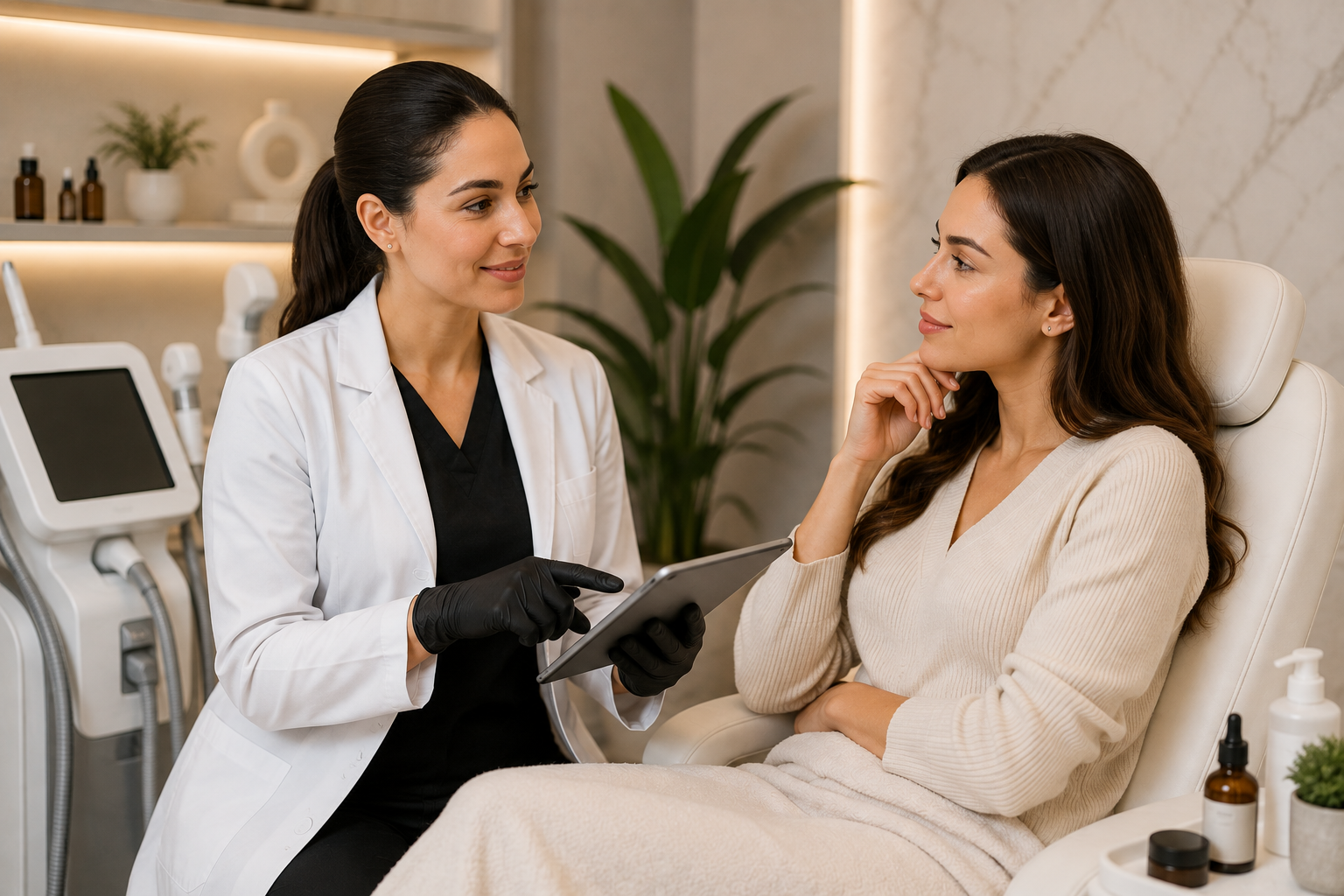
This article breaks down what medical supervision actually means, who is legally authorized to inject in Ontario, what happens when complications arise, and how to verify a clinic before you commit. At Skinfinity RX in Mississauga, every consultation starts with a health history review and a personalized treatment plan before any procedure is discussed, a process consistent with established clinical practice standards. That approach is the standard this article will help you recognize and expect.
Why Should I Choose a Medically Supervised Aesthetics Clinic? Start With the Structural Difference
Most people assume the difference between a medical aesthetics clinic and a beauty spa is cosmetic: fancier equipment, a cleaner waiting room, higher prices. The real gap is structural. It has nothing to do with decor, and everything to do with what exists behind the treatment room door.
The clinical team behind the treatment room
A regulated medical aesthetics clinic operates under a named medical director, in Ontario, typically a physician, given that the College of Physicians and Surgeons of Ontario (CPSO) framework centers physician accountability for many regulated clinical activities. Nurse practitioner involvement varies depending on local governance and clinic structure. That accountability is legal, not just professional. In contrast, many beauty spas employ estheticians and cosmetologists who are skilled at skin care but are not licensed to perform medical procedures or administer prescription injectables. The distinction matters because the procedures offered at aesthetics clinics, neuromodulators, dermal fillers, laser resurfacing, are not personal care services. They are medical interventions.
What clinical oversight looks like in practice
In a properly structured physician-led aesthetics clinic, oversight shows up in specific, documentable ways. A health history review takes place before treatment begins. Injectable planning is anatomy-based. Adverse event protocols are documented. There is a clear chain of accountability from the practitioner to the supervising physician. These aren’t marketing claims, they’re the infrastructure that distinguishes a medically supervised aesthetics clinic from a spa that has simply added an injectable menu. Spas operating without this structure may not be acting in bad faith, but they are operating without the clinical backbone that makes these procedures safe.
Who Can Legally Inject Botox and Fillers in Ontario
Ontario’s regulatory framework is clearer than most people realize. The confusion comes from how aggressively private training companies market their injector certification courses, which creates the false impression that completing a weekend program is equivalent to holding a healthcare license.
Ontario’s controlled-acts framework
Under Ontario’s Regulated Health Professions Act, administering a substance by injection is a controlled act. Only authorized healthcare professionals can legally perform these procedures. In a licensed aesthetic clinic in Ontario, that list includes physicians (MDs), nurse practitioners (NPs), physician assistants (PAs), and registered nurses (RNs), though the authorization mechanisms differ by role. RNs, for example, require a valid physician-delegated medical directive and a documented competence assessment per the Nursing Act and College of Nurses of Ontario (CNO) guidance; they cannot prescribe or authorize their own treatments independently. Estheticians and cosmetologists fall outside this authorization entirely, regardless of what private course certificates they hold.
What a valid injector credential actually looks like
The hierarchy works like this: physicians can inject, prescribe, and manage complications independently. Nurse practitioners often operate with significant autonomy under their own prescribing authority, within the scope defined by CNO and clinic governance. Registered nurses may inject under a specific physician-delegated medical directive, but require that authorizing mechanism to proceed. The Certified Aesthetic Nurse Specialist (CANS) designation from the Plastic Surgical Nursing Certification Board is a nationally recognized specialty certification for aesthetic nurses. It requires an active RN license, documented practice hours, physician endorsement, and a formal national exam. A private injector course certificate from a training company is not equivalent to any of this. It demonstrates attendance, not clinical authorization.
What Happens When Something Goes Wrong
The most persuasive case for choosing a medically supervised aesthetics clinic isn’t that complications are common, they aren’t. The case is that when complications occur, the response window is narrow. Minutes and hours matter, and the clinical setting determines what’s possible.
How medically supervised aesthetics clinics manage complications
The most serious filler complication is vascular occlusion, where filler material inadvertently compresses or enters a blood vessel, cutting off circulation to surrounding tissue. The window for effective intervention is measured in hours, not days. Established clinical protocols indicate that treatment within the first four to six hours significantly improves outcomes, while delayed recognition is directly linked to tissue necrosis and, in rare cases, visual injury. Botox complications, including ptosis, asymmetry, and brow drop, are less urgent but still require clinical assessment. Laser treatments on unassessed or unsuitable skin types carry real risks of burns, blistering, and pigmentary changes that require dermatological management.
What a supervised clinic does differently in an emergency
A licensed aesthetic clinic operating under medical supervision is more likely to carry hyaluronidase on-site, the reversal agent used to dissolve hyaluronic acid fillers in the event of a vascular occlusion, along with documented protocols for its immediate use. A physician or regulated practitioner can recognize the early signs of occlusion, administer the reversal agent promptly, prescribe any necessary medications, and coordinate urgent follow-up. Non-medical medispas and unsupervised settings are less likely to have those resources immediately available. When patients experience complications in those settings, they are often sent to a walk-in clinic or emergency room, frequently without clinical documentation of what was injected, where, or in what volume. That gap in handoff information makes management significantly harder for the receiving provider.
Why Medically Supervised Clinics Cost More, and Why the Gap Makes Sense
The price difference between a medically supervised aesthetics clinic and a retail medspa is real and worth discussing honestly. In the GTA, Botox at retail medispas is often advertised between $8 and $14 per unit, based on 2026 market pricing. At medically supervised clinics in Mississauga and Toronto, pricing typically runs from $10 to $25 per unit, with board-certified physicians or highly credentialed injectors at the higher end. Dermal fillers follow a similar pattern: retail medspa pricing often starts around $499 to $600 per syringe, while regulated clinics typically sit in the $700 to $1,200 range depending on the product and treatment area.
What the higher price actually covers
At a physician-led clinic, the pricing reflects licensed healthcare practitioners, pharmaceutical-grade products sourced through authorized Canadian channels, pre-treatment health assessments, documented emergency protocols, and accountable aftercare. These are not optional add-ons. They are the components that make a cosmetic procedure clinically appropriate rather than just commercially convenient. The cost savings at a lower-priced, unregulated setting often come from cutting exactly these components.
The real cost of a complication from an unregulated setting
A single adverse event requiring emergency care, or a corrective procedure to address a poor result, typically costs more than the entire original treatment and more than the price difference between a regulated and unregulated clinic. The savings at a spa without a medical director are not a bargain if they result in a complication that costs significantly more to fix. Some complications, particularly tissue necrosis or certain laser injuries, cannot be fully corrected at any price.
How to Verify a Clinic and What to Ask Before You Book
Choosing a regulated aesthetics clinic doesn’t require a medical degree. It requires asking the right questions before you commit, and recognizing what a confident, specific answer sounds like versus one that deflects. Use the checklist below as your starting point.
The questions every patient should ask before a first treatment
Before agreeing to any procedure at any clinic, ask these directly:
- Who will be performing my treatment, and what is their healthcare license?
- Who is the medical director of this clinic, and are they on-site during treatments?
- What is your protocol if I experience a complication during or after my procedure?
- Can you walk me through the health assessment before we begin?
- What brand of product do you use, and how is it sourced?
A legitimate medically supervised aesthetics clinic answers all of these without hesitation. Defensiveness, vague answers, or an immediate redirect to pricing before your questions are addressed are clear signals to keep looking.
What a properly credentialed clinic tells you upfront
A properly structured clinic makes their credentials visible before the appointment begins. Their consultation includes a health history review. Pricing is transparent before you arrive, not disclosed only after your appointment has begun. At Skinfinity RX in Mississauga, every consultation follows this model: credentials on file, health assessment first, treatment plan second, and pricing discussed openly so patients across the GTA can make informed decisions without pressure. That process is a useful benchmark for evaluating any clinic you’re considering.
The Question You’re Really Asking
When patients ask “Why should I choose a medically supervised aesthetics clinic?”, the real answer isn’t about paying more for a premium experience. It’s about ensuring that the person responsible for your treatment is qualified, accountable, and equipped to handle whatever happens before, during, and after your procedure, and that the clinic around them is built to support that standard.
In a market as active as the GTA, the signals worth looking for are specific: a named medical director, licensed practitioners with verifiable healthcare credentials, documented complication protocols, and a consultation that starts with your health history. These aren’t luxuries or differentiators. They’re the baseline for safe, clinical care, and knowing what to look for puts you in a much stronger position as a patient.
If you want to experience what a properly supervised aesthetics clinic looks and feels like in practice, reach out to the team at Skinfinity RX to book a consultation. It’s a low-pressure starting point, and it gives you a clear reference point for evaluating any other clinic you’re considering.

Director, Aesthetician at Skinfinity Aesthetics
Request a Consultation
LIMITED APPOINTMENTS AVAILABLE